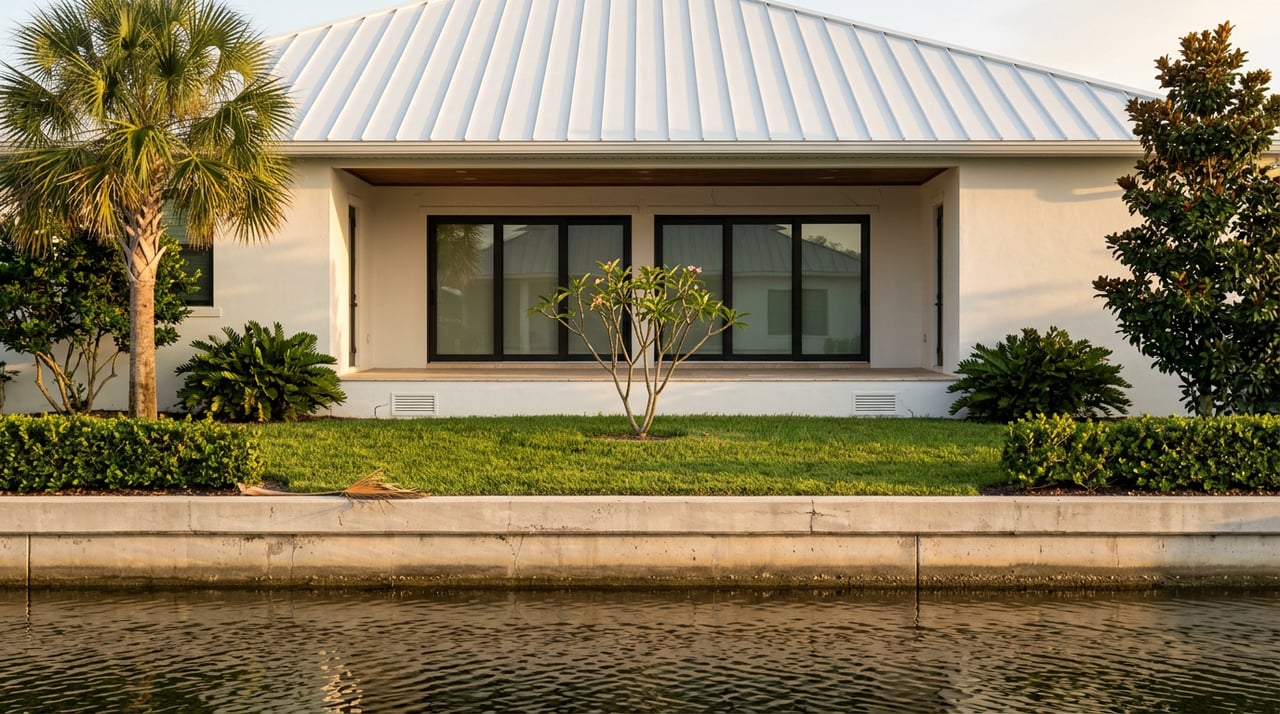
A buyer looking at Venetian Isles from out of state sees one number on the portals and one neighborhood on the map. Both are misleading. The canals are the same. The lots are the same. The product on top of them is no longer the same.
Since Hurricanes Helene and Milton in fall 2024, the question that decides what your money actually buys here is not square footage or canal width. It is whether the home in front of you crossed a single regulatory line: 49 percent.
The thesis in one line. Venetian Isles is now two markets sharing one ZIP code. Renovated and elevated homes are trading on lifestyle. Pre-storm slab-on-grade homes are trading on dirt. The same listing site shows both, and the price tag rarely tells you which one you are reading.
The Rule That Quietly Reorganized the Neighborhood
Every St. Petersburg home inside the Special Flood Hazard Area is subject to what the city calls the Substantial Damage Rule. Per the City of St. Petersburg Floodplain Management Ordinance, repairs that cumulatively equal or exceed 49 percent of the pre-damage market value of the structure require the entire building to come into compliance with current floodplain code. Land value is excluded from the math. The 49% threshold is the city's municipal decrement of the federal FEMA standard, and the inspector's job is to determine whether storm damage surpassed it.
For a 1968 ranch on a Venetian Isles canal, "compliance" usually means elevating the lowest habitable floor. Pinellas County requires construction to Base Flood Elevation plus one foot of freeboard, so a parcel with a 9-foot NAVD88 BFE must have its lowest habitable floor at 10 feet. On a mid-century slab home sitting roughly at BFE, that is not a renovation. That is a lift, a rebuild, or a teardown.
Two more details quietly do most of the work:
- The lookback. The 50% threshold is calculated over a rolling 12-month window, not per permit, so multiple smaller projects in the same year are added together.
- The valuation. An owner can pull a free FEMA/WLM Letter through pcpao.gov, which sets the structure value used in the 49% math; everything you spend on repairs counts against that figure. That automated number is known to run 20 to 40 percent below a defensible market-replacement number, which is why owners close to the threshold often pay $400 to $700 for a private retrospective appraisal.
Why this matters at a closing table: the same canal-front lot can be a $900K live-in renovation for the buyer whose contractor stays under 49 percent, and a $1.4M elevated rebuild for the buyer whose scope tips over it.
What the Listings Are Actually Telling You
Read ten current Venetian Isles listings in a row and a vocabulary emerges that did not exist two years ago. Sellers and their agents now signal which side of the line the home sits on, in code:
Listing language | What it usually means in 49%-rule terms |
|---|---|
"High and dry," "did not flood," "no surge issues" | Owner is signaling no substantial damage letter, so a buyer can renovate at scale without triggering elevation |
"Professionally remediated per FEMA guidelines" | Drywall cut to the flood line and dried; buyer inherits the structure and its current FEMA letter value |
"Substantially damaged letter received" | Buyer cannot renovate the existing footprint, but can lift to code or build new |
"Priced at land value" / "cash only, no inspection" | The structure is essentially a demolition allowance against the dirt |
"Elevated new construction, main living at X feet above BFE" | A finished compliant product priced accordingly |
This is the bifurcation in plain text. Pinellas MLS activity for Venetian Isles over the year ending March 2026 shows 41 closings at an average sale price of about $1.62M, a 92% list-to-sell ratio, $442 per square foot, and 93 days on market. That single average is the arithmetic mean of a $775K cash-only teardown and a $5.95M open-water rebuild, sitting on the same MLS page in the same week.
The takeaway for a relocation buyer: the "median Venetian Isles home" is a statistical fiction right now. There are renovated and new-construction homes, and there are lots with houses on them. Pricing them against each other is the entire game.
Elevation Is a Block-by-Block Question
The neighborhood was originally built as a submerged-land fill project at roughly 5 to 7 feet above the natural shoreline, which is why most homes here had been spared significant flooding for more than five decades before 2024. Helene was the exception, and it was not uniform. The neighborhood sits in broad AE zone coverage, and the mid-century slab-on-grade homes here often sit at or just above Base Flood Elevation, which is why elevation strategy is critical for any significant renovation.
A few practical implications a portal will not tell you:
- Interior streets and slightly higher grades performed better than open-bay frontage. Michigan Avenue, for example, has been marketed in recent listings as one of the highest streets in the community. Two homes a block apart can have entirely different substantial damage letters.
- Concrete block plus elevated construction outperformed everything else. Newer block homes with impact glass and elevated finished floors largely came through both storms without surge damage to living space. The eight-home Venetian Place enclave is the most cited local example of that pattern.
- Seawall age is a balance-sheet item, not a footnote. The Venetian Isles Homeowners Association has long maintained a dredging and seawall committee, but the actual seawall on a given lot is the owner's responsibility, and replacement runs well into six figures on a standard lot.
For a buyer comparing two canal-front homes at similar asking prices—or weighing options across St. Pete's premier coastal enclaves, such as buying a waterfront home on Snell Isle—the seawall installation year, the finished-floor elevation, and whether a substantial damage letter was issued matter more than countertops.
The Friction That Only Surfaces During a Transaction
A few items that catch out-of-state buyers and even some local agents:
- Unpermitted post-storm repairs are a title-stage problem. The City of St. Petersburg has been monitoring properties for FEMA compliance, and Pinellas County has waived penalties for after-the-fact permits through June 30, 2026, though standard permit fees still apply. A home with drywall and electrical replaced without a permit becomes the buyer's problem after closing.
- The 25% NFIP discount is community-wide and conditional. St. Petersburg residents currently receive a 25% discount on National Flood Insurance Program premiums, and that discount depends on the city staying in compliance with floodplain regulations. Buying a non-compliant home undermines both your own premium and the neighborhood's. Understanding the details of flood insurance in St. Petersburg before writing an offer is essential.
- Increased Cost of Compliance coverage is real money but capped. Policyholders of substantially damaged structures in a Special Flood Hazard Area can receive up to $30,000 through ICC to help meet the cost of complying with building codes. On a full elevation, $30K is a meaningful contribution to a six- or seven-figure scope.
- Scale of the recovery is still shaping inventory. Hurricanes Helene and Milton damaged nearly 16,000 homes in St. Petersburg. A meaningful share of the city's repair and rebuild capacity, from contractors to engineers to surveyors, is still committed to that backlog.
New construction is filling part of the gap. Sibley Homes and MINU Homes are both active in the neighborhood right now, with at least one MINU project under construction on an oversized lot and a Sibley-built canal home recently brought to market as a finished rebuild.
How to Read a Venetian Isles Offer Like an Insider
Before you write a number on a contract here, review our comprehensive tips on buying waterfront homes in St. Petersburg and work through the same short checklist a local listing agent would:
- Pull the FEMA/WLM Letter for the parcel from pcpao.gov and note the structure value.
- Ask the seller, in writing, whether a Substantial Damage determination letter was issued.
- Get the finished-floor elevation in NAVD88, not "we are high and dry."
- Confirm the seawall installation year and any open VIHA assessments.
- Confirm every post-storm repair was permitted, with closeout inspections completed.
A clean answer to all five is what separates a $1.6M home from a $1.6M project.
FAQ
Did all of Venetian Isles flood during Helene? No. Damage varied significantly by street and by finished-floor elevation. Higher interior streets and elevated newer construction generally performed better than older slab homes on open-bay exposure.
Is the 49% rule really stricter than the federal 50% rule? Functionally, yes. The City of St. Petersburg uses 49% as its trigger, and the rolling 12-month lookback means cumulative permitted work counts toward the threshold.
Can I appeal a Substantial Damage determination? Yes. The most common path is a state-licensed retrospective Actual Cash Value appraisal showing a higher pre-storm structure value than the county's FEMA Letter reflects.
Is now a bad time to buy here? It depends on which product you are buying. Elevated and substantially renovated homes are trading on lifestyle fundamentals that have not changed: sailboat-depth canals, golf-cart proximity to downtown, and direct Tampa Bay access. Land-value buys carry construction risk that is not for everyone.
If you are weighing a Venetian Isles purchase from out of state, or deciding whether the home you already own here is a candidate for a rebuild or an updated home valuation, that decision deserves a conversation with someone who has read the FEMA letter, walked the seawall, and priced the elevation scope. Plotkin Homes works this neighborhood block by block. Contact us when you are ready to look past the listing photos.
