Most St. Pete neighborhoods get their identity from a corridor. The Edge District has Central Avenue. Magnolia Heights has MLK. Old Northeast has its bayfront parks and the walking culture that comes with them. When residents in those places talk about why they stay, they eventually name a coffee shop, a bar, a farmers market, a strip of blocks that feels like theirs.
Roser Park skipped that model entirely. The 270-acre district — bounded by 4th Street, Dr. Martin Luther King Jr. Street, Booker Creek, and Ingleside Avenue — holds roughly 173 homes, a creek, some of the only hills in the city, and no commercial presence to speak of inside its boundaries. What it built instead is a civic calendar so dense it functions like infrastructure. That choice, made more than a century ago, is what makes the neighborhood recognizable in 2026 in a way that no restaurant could.
A Neighborhood Designed as a Retreat
Charles Martin Roser came to St. Petersburg in 1910 with money he is widely believed to have made selling the Fig Newton recipe to the National Biscuit Company, the predecessor to Nabisco. He bought land along Booker Creek on the outskirts of the city's established development, and he built a neighborhood that operated on the principles of the City Beautiful movement: broad streets, park space, a mix of architectural styles meant to attract buyers with different tastes and budgets.
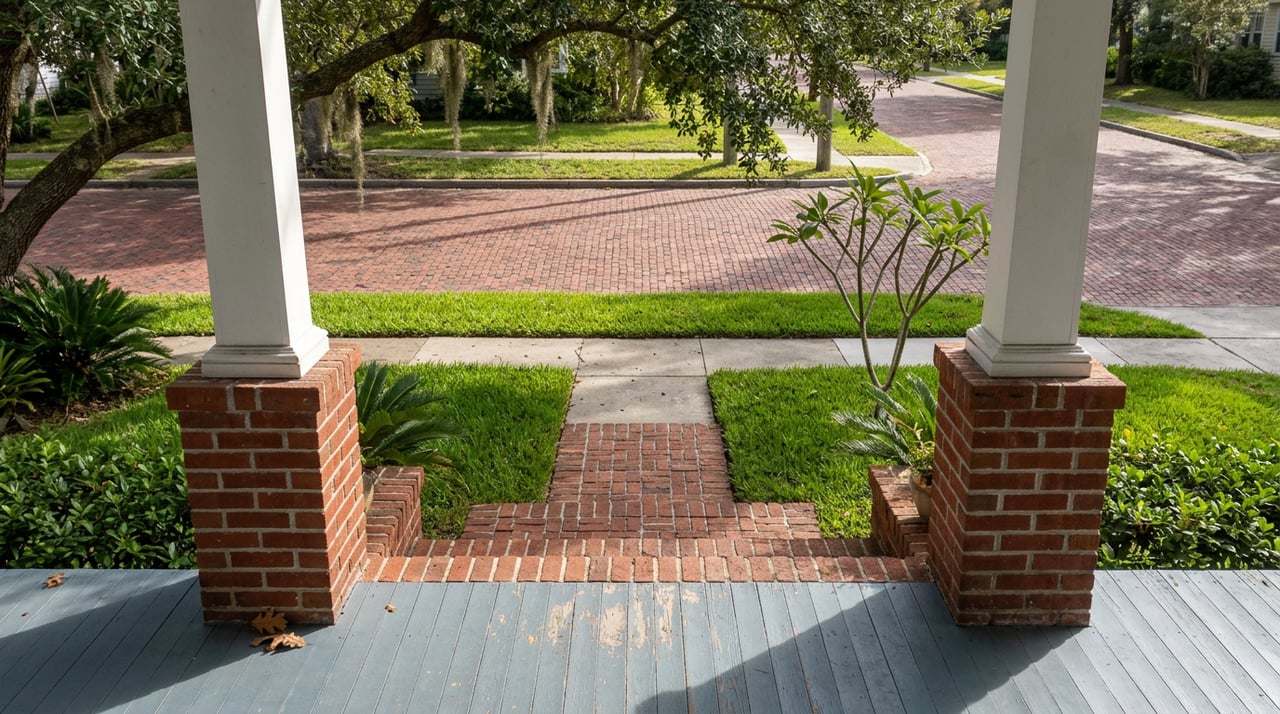
In 1918, Roser gifted much of that land — including Booker Creek itself — to the city. The neighborhood became St. Petersburg's first designated local historic district, and it has held that status ever since. The architecture reflects every phase of early 20th-century residential design: Frame Vernacular bungalows, Dutch Colonial and Craftsman homes, American Foursquares, Mediterranean Revival, Neoclassical. The brick streets were not a period affectation — they were the original paving, and they remain.
The point of rehearsing this history is not sentiment. It is that Roser Park was designed from the start to be self-contained rather than commercially anchored. That original design decision locked the neighborhood into a path: if community life was going to exist here, residents would have to build it themselves.
What the Calendar Actually Looks Like
The Historic Roser Park Neighborhood Association has been running programming for years, and the current event slate for a neighborhood of roughly 173 homes is worth reading in full:
- Tour of Homes — an annual ticketed event ($15 in advance, $20 at the door) opening a selection of the neighborhood's most architecturally significant homes. The 2026 edition ran March 21.
- Porchfest — held the same day as the Tour of Homes, free and unticketed. Local musicians set up on front porches across the neighborhood; attendees move between them on foot. Vendors and food trucks on site.
- Booker Creek Luminaries — an HRPNA-sponsored tradition. Luminaries are placed along the creek path by 7 p.m. and residents are invited to walk the route after dark.
- Ghostfest — a fall evening event, most recently November 15, 2025, running 4 to 9 p.m.
- Movie nights — residents bring chairs or blankets and sit on a grassy slope to watch films. The Valentine's edition featured a romantic comedy, with popcorn provided.
- June Porch Party — hosted by residents (Domenico Pontoriero has been a recurring host), an informal evening gathering that moves the social life outside.
- Creekfest — a newer event just announced by the association, details still forming.
- Member events at the St. Petersburg Museum of History — for HRPNA members, exclusive access to historical programming and socializing tied to the neighborhood's documented past.
Eight distinct events. One neighborhood. The ratio matters — most neighborhoods in this city, even beloved and well-organized ones, manage three or four recurring events a year. Roser Park is running a schedule that would be ambitious for a district ten times its size.
The reason is straightforward: without a coffee shop to anchor a morning routine or a wine bar to anchor a Friday night, the neighborhood association became the programmer. Every event on that list is doing the work that a commercial corridor does passively in other places.
The Outdoor Museum Is Getting Its First Update in Decades
Running along Booker Creek from 4th Street South toward Martin Luther King Jr. Street, then branching into the surrounding blocks, is the Historic Outdoor Museum of Roser Park. Long-time resident Ron Motyka created it; the grand opening was held in 1999 with Mayor David Fischer present. The museum consists of 28 markers mounted on wrought-iron poles, each describing a historic home or aspect of neighborhood life, some showing early 20th-century photographs from when horses and blacksmith shops still served the city.
As of 2025 and carrying into 2026, the HRPNA is in the process of restoring and renovating all existing markers in collaboration with the St. Petersburg Museum of History. For residents who walk the creek path regularly, this is not a minor preservation detail. It is the active maintenance of the neighborhood's own self-told story — and it gives the outdoor walk something that most park walks in the city do not have: a reason to stop and read.
One tree along that path has earned a name. A sprawling live oak arches over the creek and serves as a meeting-point reference for locals who call it Charles — named after the founder. "Meet me by Charles" is an actual navigational instruction in this neighborhood. The tree is a named local entity in the most literal possible sense.
What a Saturday Actually Feels Like
The physical experience of Roser Park is unusual enough that first-time visitors often say some version of the same thing: this doesn't feel like Florida. The streets do not run in the standard grid. They wind. The terrain rises and falls in a way that is genuinely rare in Pinellas County. The oak canopy closes overhead on the interior blocks. The brick paving slows traffic organically — not by ordinance, but by texture.
The park itself sits in a small valley below the surrounding homes. Booker Creek runs alongside a brick path. The sound of water is present even when no one else is around. On Tour of Homes weekend, the porches that normally hold a single household's morning coffee become stages. On luminaries night, the creek path fills with neighbors who do not need a business to give them a reason to be outside together.
What is absent from this picture is also part of the picture. There is no pour-over coffee debate here, no line outside a new brunch spot, no noise ordinance complaint. The neighborhood earns its peace by programming its own public life and then stepping back from it. The Dali Museum, the Duke Energy Center for the Performing Arts, Kahwa Coffee, and the Central Arts District are all within biking distance. The neighborhood's internal quiet is not isolation — it is a design.
That design is still working. Residents consistently describe Roser Park as a place they did not expect to find and do not want to leave. The housing stock that supports it — Craftsman bungalows, Mediterranean Revival homes, a mix running from the lower $400,000s to above $1 million — turns over slowly. When a home becomes available, it moves.
If you are thinking about what it means to own in Roser Park, or in one of the surrounding neighborhoods that shares its proximity to downtown and the bayfront, Plotkin Homes can give you the block-by-block context that makes the difference. Reach out when you are ready.
