St. Petersburg has remade itself at a pace that catches long-time residents off guard. Corridors that looked nothing like this five years ago now draw lines out the door on Saturday mornings. Property values in neighborhoods that were once afterthoughts have climbed past neighborhoods that used to define the city's upper tier. And through all of it, Old Southeast has remained largely, stubbornly, recognizably itself.
That's not luck. It's policy — and understanding it changes how you see your own block.
The Grid Beneath Your Feet
Most St. Pete neighborhoods follow a conventional rectangular street pattern. Old Southeast doesn't. The neighborhood is a designated hex-block preservation district, meaning the hexagonal street geometry is a protected feature, not a historical accident waiting to be rationalized away by a road-widening project. The result is a grid that slows traffic, shortens cut-through appeal, and rewards people on foot.
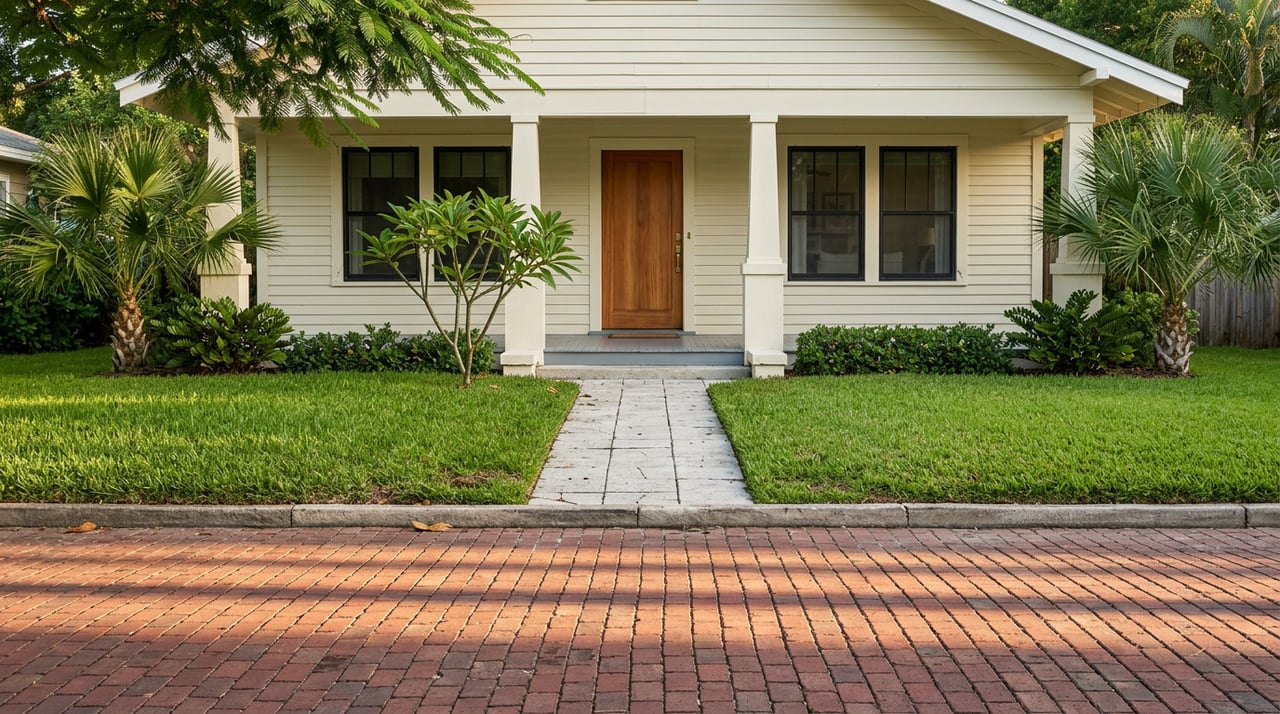
About 500 single-family homes fill those blocks, most of them built between the 1920s and 1950s. Craftsman bungalows sit beside mid-century ranch houses on streets lined with mature canopy. The density is residential without being suburban — you can walk to Bayboro Harbor Marina in the time it takes most neighborhoods to reach a traffic light worth complaining about.
To the north, USF St. Petersburg sits close enough that students and faculty bleed into the neighborhood's daily rhythm without overwhelming it. To the west, Fourth Street South marks the outer edge, keeping the whole neighborhood accessible without dissolving the boundary that gives it shape. Less than two miles of relatively flat ground separates OSE from downtown. On a bike, on a clear morning, that distance disappears.
The Waterfront the Rest of the City Doesn't Quite Know About
Lassing Park runs along the neighborhood's eastern edge at Beach Drive SE and 18th Avenue SE — 14.2 acres of grass and shoreline facing Tampa Bay. Judge Robert B. Lassing donated the original waterfront land to the city in 1924 with one condition: all future structures had to serve park-related purposes. The city expanded the footprint three more times before officially dedicating the park in 1942. The condition held.
What that means on a Tuesday morning is open space you can actually use. Kayakers and paddleboarders launch from the shore. Crab cages go in off the seawall. On windy days, kite surfers work the bay. Sunrise here is a legitimate reason to set an earlier alarm.
The park is a passive natural park — no concessions, no programming, no infrastructure that changes how it feels year to year. That has made it a neighborhood asset of the rarest kind: one that simply stays.
South of the park along Salt Creek, the working waterfront takes over. The stretch residents call Sailboat Row — anchored around the Salt Creek Marine Yacht Basin along 14th through 17th Avenues South, east of Third Street — operates more like a working harbor than a pleasure marina. The Coast Guard station sits nearby. Sailboats rest in dry dock along the avenue. The Big Catch at Salt Creek brings live music and a menu of seafood that leans into the Old Florida setting, not away from it.
Two Places That Explain the Food Scene
The food situation in OSE is not a scene. It's a rhythm. Two places define it.
Old Southeast Market at 1700 Third Street South is open every day from 7 a.m. to 9 p.m. It does poke bowls, deli sandwiches, gourmet donuts, fresh produce, and coffee from a shop that feels like it belongs to the neighborhood rather than to a concept. The patio faces the marina area. It's the kind of place that gets described as a "hidden gem" by visitors and quietly anchors the daily routine for people who live within walking distance.
The Chattaway, at 358 22nd Avenue Southeast, is the neighborhood's longer-running institution. Award-winning burgers, an open-air garden space, and a setting that has resisted the renovation impulse that has touched so much of St. Pete's dining stock. The Chattaway parking lot also doubles as the pickup point for Artist Enclave Studio Tour maps — a detail that says something about how the neighborhood thinks about its institutions.
The Vote That Explains Everything Else
In 2013, Old Southeast residents voted to ask the city for a formal Artist Enclave designation. The vote was overwhelming. The city granted it in 2014, making OSE one of only two St. Petersburg neighborhoods to carry this designation — Historic Kenwood being the other.
The designation is not ceremonial. Under it, Old Southeast artists are legally permitted to use their residences as working studios, artist lofts, galleries, and instructional spaces. They can sell work directly from their homes. The city's zoning framework actively protects that use rather than treating it as a variance problem to be managed.
What that produces, twelve years later, is a neighborhood where the studios are not in a dedicated arts district — they're in the houses. Walk the hex blocks and you're walking past active creative operations: a ceramic artist hand-building vessels in one bungalow, a letterpress printer running cards and posters on an 1879 treadle press a few streets over, a stained-glass artist who has worked in the same house for more than five decades. The OSNA's artist directory, still being built out, currently lists residents including:
- Amanda Badgley Westenberg — ceramics, hand-built vessels
- St. Pete Seahorse — letterpress printing and linocut on 100% cotton paper using an 1879 Model treadle press
- Deb Ferber — mixed media
The annual Artist Enclave Studio Tour runs as a free, self-guided walk through open studios across the neighborhood. You pick up a map at The Chattaway. The OSNA confirmed that 2026 is shaping up to be the most active year yet for the enclave, with a full lineup of events beyond the Studio Tour.
This is the mechanism. When residents ask why OSE feels different from other neighborhoods that have absorbed St. Pete's growth without retaining much character, the answer runs through a vote that happened over a decade ago. The Artist Enclave designation didn't create the neighborhood's creative identity — artists were already here. What the vote did was give that identity a legal backbone. It made it harder for the neighborhood to drift toward the kind of homogenization that has reshaped other corridors nearby.
What Saturday Actually Looks Like
You start at Lassing Park. The bay is flat or it isn't — either way, the 14.2 acres are yours. You walk the shoreline north, past the spot where the sandbars emerge at low tide, and loop back through the hex blocks toward Third Street.
Old Southeast Market is open. The coffee is ready. If you want something more substantial, the poke bowls are built in front of you from ingredients that arrived this morning.
By midday, The Chattaway's garden is doing what it always does: operating outside the logic of whatever the rest of the city is concerned with. It's been here long enough to have its own gravity.
In the afternoon, if you know where to look, you'll find studios. A ceramics workshop behind a bungalow gate. A letterpress shop off a side street. The OSNA's Studio Tour map, when the annual event runs, connects them into a walkable route — but the studios exist year-round, not just on tour day.
None of this is the kind of Saturday that photographs into a story about St. Pete's transformation. It's quieter than that. The neighborhood didn't position itself against the city's growth so much as it organized early, voted deliberately, and created the conditions for a particular kind of daily life to persist.
Twelve years after the vote, it's still holding.
If you're thinking about Old Southeast — whether you're already here or considering a move to this part of St. Pete — the team at Plotkin Homes works this market with the kind of block-by-block knowledge that only comes from being here. Reach out to start a conversation.
